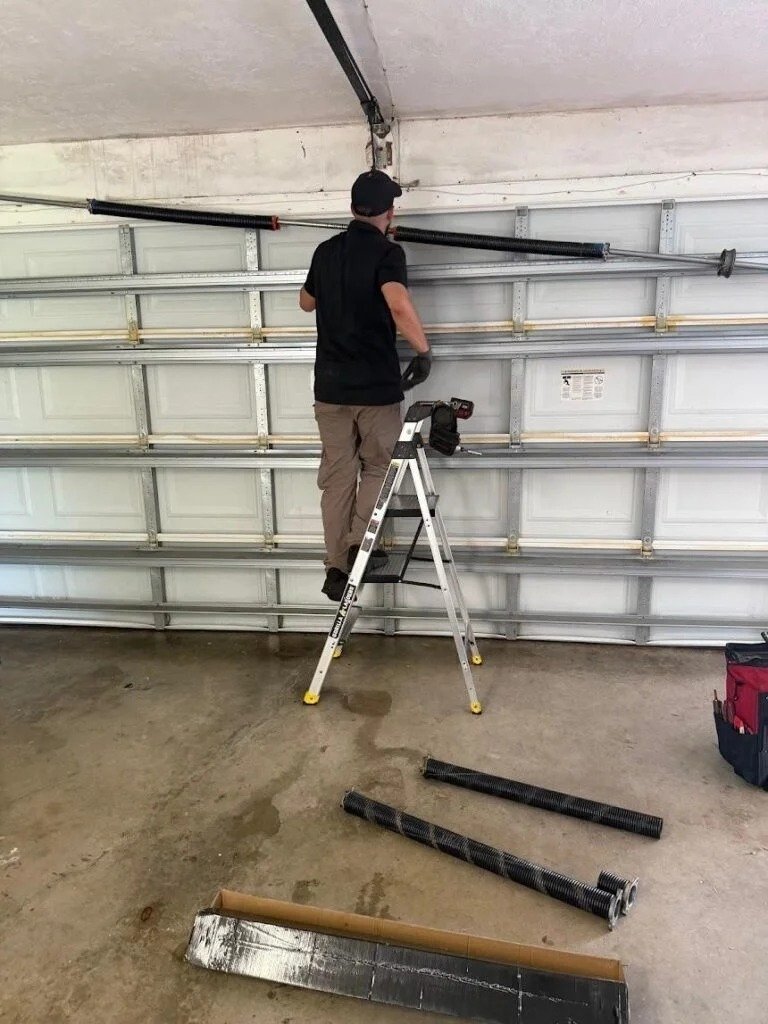
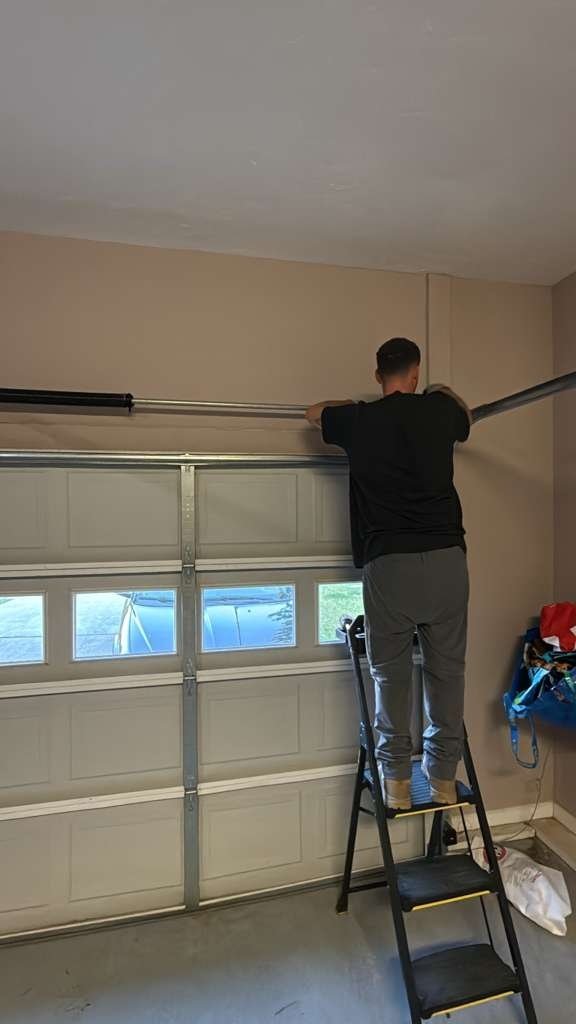
A broken garage door spring is replaced with a new one sized to your door's actual weight, and the door should stay closed until that is done. Torsion springs are mounted across the top of the opening on a shaft and store energy by winding tighter as the door comes down. Extension springs run alongside the horizontal tracks and store it by stretching. Either way the spring, not the opener, holds up the door, so once it breaks the door weighs what it weighs, often well over a hundred pounds.
Springs are rated in cycles, one cycle being a full open and close. One manufacturer's guide puts torsion springs at about 10,000 to 15,000 cycles and extension springs at about 5,000 to 10,000, which works out to roughly seven to ten years at four cycles a day for a torsion spring. We measure the wire size, length and inside diameter, weigh the door, wind the new spring to the correct turns with winding bars and set the cable tension. On a two-spring door we replace both, as industry safety guidance advises, because the second one has the same age and the same cycle count.
How a broken spring shows up
- A gunshot-loud bang from the garage, then silence
- A visible gap in the coil of a torsion spring above the door
- Door rises a hand width, then sinks again
- The opener strains, hums or stops mid-travel
- The door feels far heavier than usual when lifted by hand
- Coils look dull, pitted or rust-brown before they ever break
The Northern Virginia Freeze and Brine Factor
Two local conditions shorten spring life here. Humidity and road brine settle between the coils of a bare steel spring, and a manufacturer's guidance notes that damp conditions make springs rust and weaken sooner. The second is workload: commuter households often cycle a door four times a day or more, and a spring's rating is counted in cycles, not years.
Winter adds a third. With roughly 102 days a year at or below freezing at the Dulles airport station, ice and packed snow along the bottom edge make the door heavier on the cold mornings when it is in daily use. We lean toward coated, higher-cycle springs on busy doors.
How We Handle It
Weigh and measure
Door weight, wire size, spring length and inside diameter, with insulation and any glass counted in the math.
Exact quote first
The correct spring set, priced on site and approved by you before anything is unwound.
Controlled replacement
Winding bars, the right number of turns, new cable tension and a check of the drums and bottom brackets while the load is off.
Balance proof
The door must hold itself near half-open, and the opener then runs full cycles against the new balance.
Spring jobs in pictures